


Digital Employee Experience in 2026: key takeaways from the ClearBox report
Digital Employee Experience in 2026 looks very different than it did just a few years ago. Back then, conversations about intranets and Employee Experience platforms were primarily technology-driven. Integrations, security, and IT scope defined the scale of the project, and success was measured by one simple criterion: whether the system worked. The Intranet and Employee Experience Platforms 2026 report by ClearBox shows that the market has largely moved beyond this phase.
By 2026, core EX capabilities will no longer be a technical challenge, and as the technology has matured, expectations have shifted as well. Instead of asking how to implement a platform, organizations are increasingly asking how to use it effectively in day-to-day work. The intranet is returning to its original role as the front door to the organization: a single, coherent access point to information, tools, and services that structures the employee experience rather than merely supporting communication.
Against this backdrop, ClearBox examines eight key areas of Digital Employee Experience, identifying which capabilities have become market standards in 2026. This provides a natural benchmark for assessing existing tools and their alignment with modern ways of working. As personalization, mobility, and AI support move from differentiators to baseline expectations, solutions designed for an earlier era of work are no longer just falling behind the market. Increasingly, they begin to limit the quality of the employee experience itself.
1. Digital Employee Experience in 2026: personalization over feature quantity
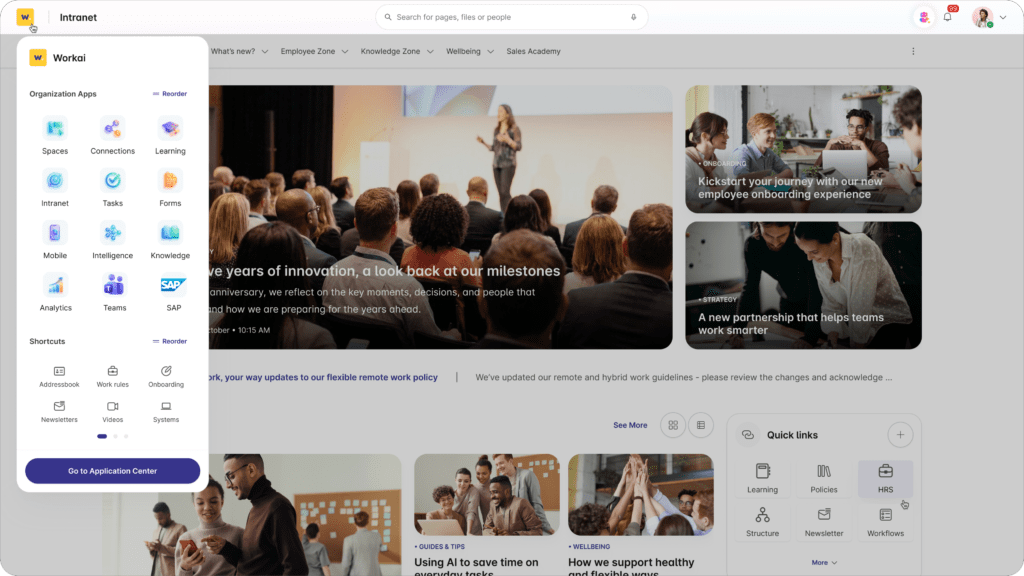
With technology no longer acting as a barrier, the focus shifts to how employees actually use EX platforms on a daily basis. Market maturity is no longer defined by the number of available features, but by whether the system helps users navigate an overload of information and tasks. This is why Employee Experience has become one of the primary areas where platforms truly differentiate.
High scores in this category (an average of 4.02 out of 5) indicate that the market has converged around a shared UX standard. Intuitive interfaces, responsiveness, and visual polish are no longer competitive advantages. They are simply expected.
Real differentiation begins where a “nice interface” stops being enough. Personalization becomes critical, not as a static division by department or role, but as dynamic content alignment with work context, location, and usage patterns. The goal is not to show more, but to show what matters in a given moment.
The ClearBox report makes this explicit: the biggest challenge organizations face is not a lack of information, but an excess of it. Platforms that can reduce information noise and guide users to relevant content have a tangible impact on the employee experience.
AI plays an increasingly important role here, not as a content factory, but as a structuring layer that summarizes, recommends, translates, and adapts content formats. In global organizations, these capabilities are becoming a matter of accessibility rather than a “nice to have.”
2. Internal communication: from publishing content to managing impact
Even the best-designed user experience quickly reveals its limits if it is not supported by structured communication. A highly personalized interface will fall short if the organization cannot plan, coordinate, and evaluate its communication activities. At this stage, attention shifts from UX itself to the processes behind content creation and distribution.
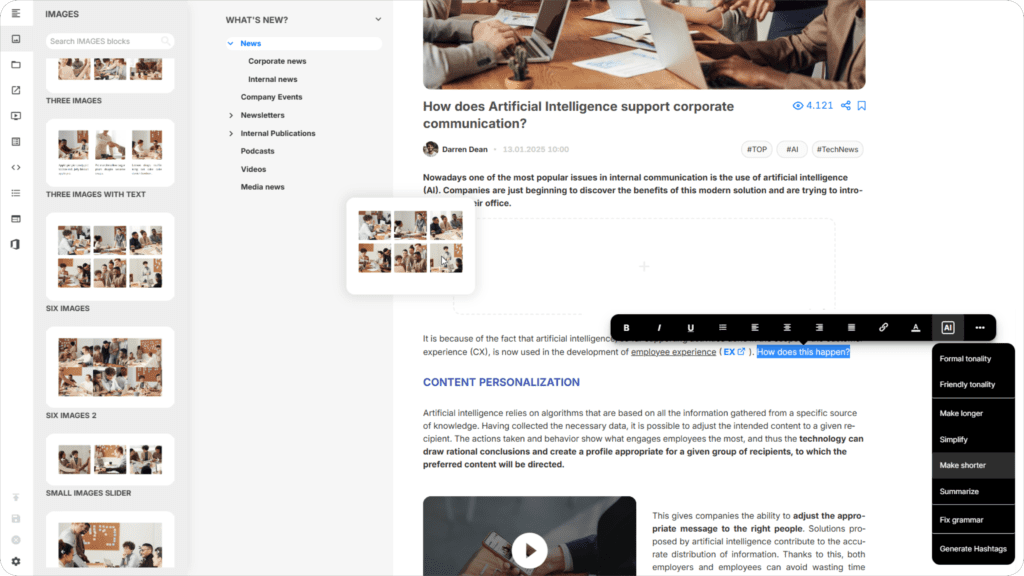
The ClearBox report highlights a clear change in how EX platforms are designed. More and more functionality is built for internal communications teams rather than solely for system administrators. Advanced newsletter editors, communication campaigns, and multi-channel distribution are no longer optional—they are becoming standard.
At the same time, this is where one of the market’s biggest maturity gaps becomes visible. Managing communication as an end-to-end process – from planning through execution to performance evaluation – varies widely across platforms. The inclusion of campaign analytics in the 2026 assessment lowered average scores in this category, clearly showing that communication analytics still lag behind organizational ambitions.
3. Employee engagement: social features are only the starting point
When communication is treated as a process rather than a series of isolated posts, the question of relationships naturally follows. Sharing information is one thing; sustaining engagement in distributed and hybrid work environments is another challenge altogether. In this context, community features stop being add-ons and start acting as organizational glue.
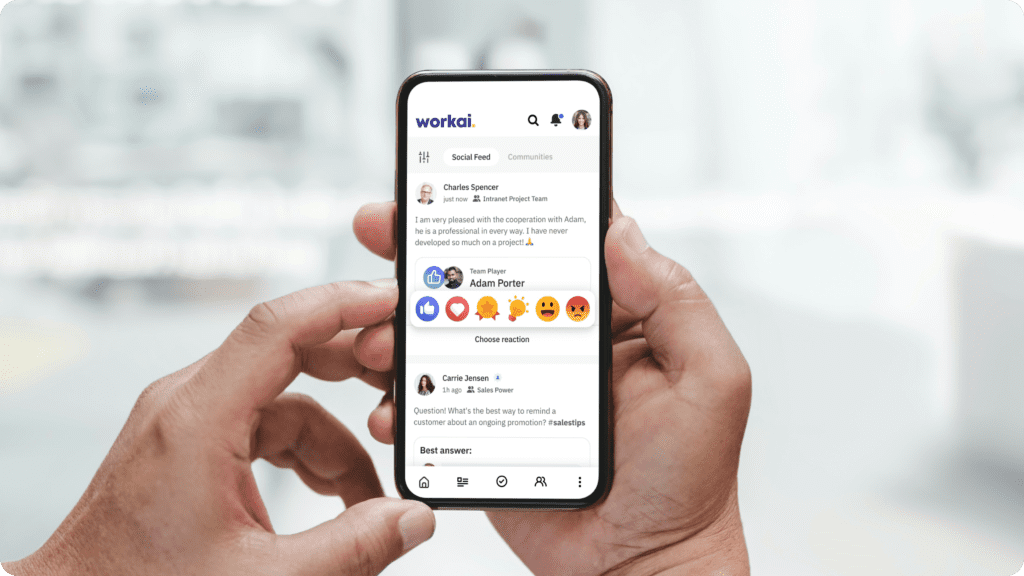
The discontinuation of Workplace by Meta accelerated the development of social features within EX platforms. Live streams, reactions, ephemeral formats, and comments have become commonplace. Yet the ClearBox report makes it clear that social-media-style mechanics alone do not create lasting engagement.
Context is what truly matters. Increasingly, platforms rely on Journeys—structured paths that guide employees through key moments in the employee lifecycle. Onboarding, role changes, returns from extended leave, or offboarding are no longer single messages. They become experiences that combine content, tasks, and social interaction.
This is where EX platforms begin to have a real impact on organizational culture, particularly in distributed environments where informal, incidental contact no longer happens naturally.
4. Integrations: the intranet as a gateway
Engagement and a sense of belonging matter, but they do not replace daily operational work. As social capabilities expand, expectations grow around whether EX platforms can support real tasks rather than just communication about work. At this point, the intranet starts to be seen not as a bulletin board, but as a potential work environment.
Modern EX platforms increasingly aim to be places where employees can not only find information, but also take action. The ClearBox report shows, however, that in 2026 most integrations remain largely presentational. Systems can display data from other tools, but far less often allow users to act on it.
Display-only integrations dominate. While the market frequently talks about AI agents, they are still the exception rather than the rule in mature products. The same applies to integrations within the Microsoft ecosystem: they are widespread, but their depth and practical usefulness vary significantly.
As a result, the intranet often serves as a central access point to tools and data, but much less frequently as the place where work actually happens.
5. Knowledge management: the intranet as a source of truth
As more processes, information, and tools converge around a single platform, the need to organize knowledge becomes increasingly visible. Without a coherent approach to reference content, even the best-integrated intranet quickly loses credibility. This is where EX moves beyond what is merely “current” and starts taking responsibility for what is stable and authoritative.
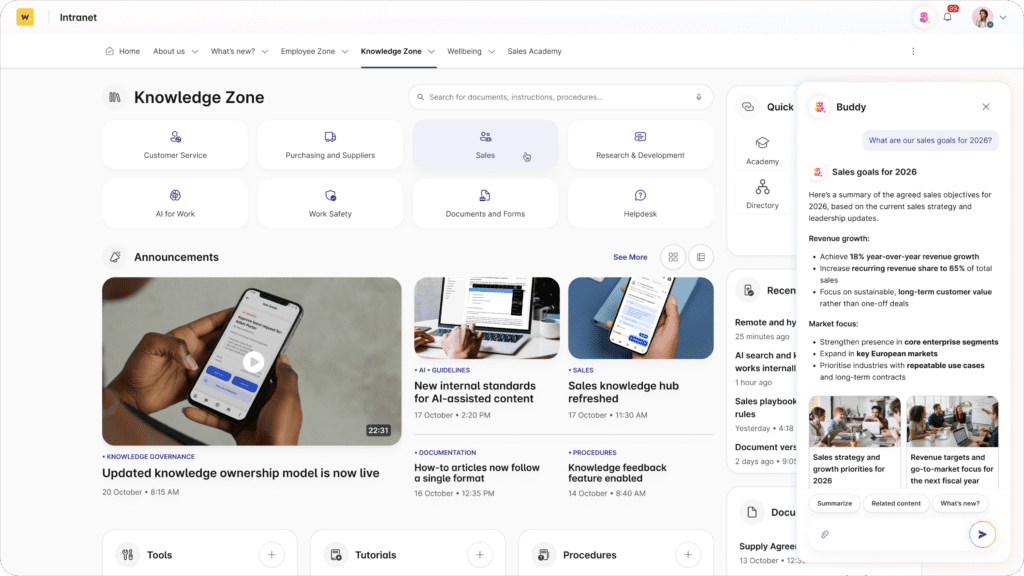
One of the most important signals in the ClearBox 2026 report is the separation of knowledge management into its own category. This confirms the changing role of the intranet as a repository for enduring knowledge – policies, procedures, and reference documents.
At the same time, organizations continue to struggle with content governance. Managing content lifecycles, ownership, and quality remains a challenge. While news reach is easy to measure, the real value of expert and reference content still resists simple metrics.
6. Search: AI improves discovery
Having knowledge is one thing; being able to find it quickly determines its real value. As the intranet becomes a central repository, search turns into one of the most critical elements of the employee experience. This is where users most quickly judge whether a platform truly makes work easier or merely relocates existing problems.
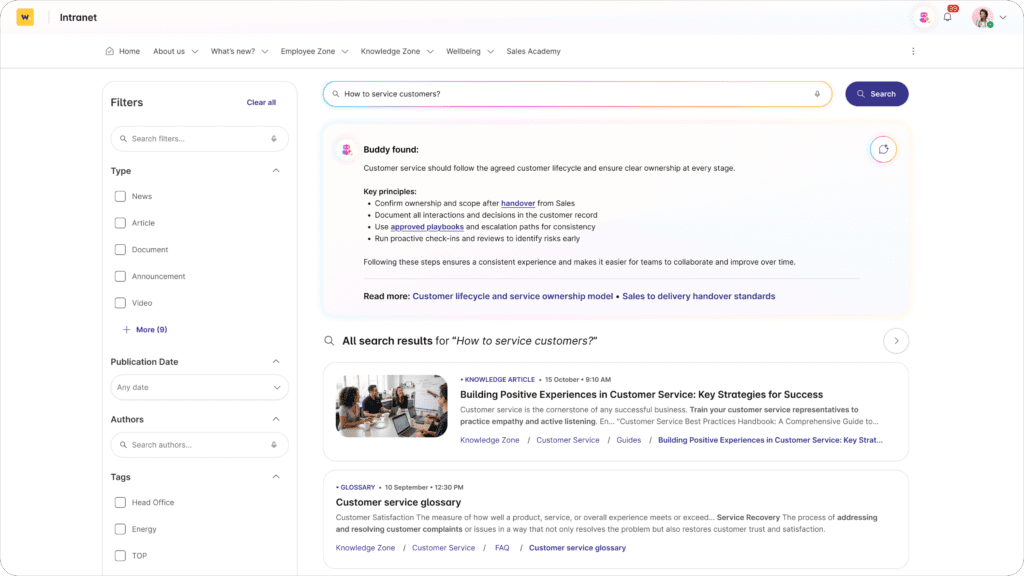
Around 75% of analyzed platforms now offer AI-assisted search. The most mature solutions combine traditional result lists with AI-generated summaries, clearly indicate sources, and allow users to refine their queries. Not only the technology is changing, but also how search is used – it increasingly resembles a conversation rather than a sequence of keyword queries.
The ClearBox report emphasizes, however, that effective search is not just about algorithms. Administrative tools such as promoted results show that findability is becoming a matter of deliberate content management. Without well-structured sources and clear priorities, even the most advanced AI-powered search will fall short.
In practice, this means search is no longer just a technical feature. It becomes a reflection of content quality and of how well the organization manages its knowledge.
7. Mobile and frontline: consumer-grade expectations at work
Search, knowledge, and communication do not stop with office workers. The ClearBox report clearly shows that a growing share of the workforce operates away from desks, in conditions that require a fundamentally different approach to user experience. In this context, mobile stops being “another channel” and starts shaping how the entire EX platform is designed.
In 2026, mobility is no longer an add-on or an extension of the intranet. It is one of the primary criteria for evaluating EX platforms. ClearBox highlights that mobile experiences must meet consumer app standards—fast, intuitive, and designed for real-world usage rather than as scaled-down desktop versions.
The frontline perspective is especially important. Employees working shifts, without constant desk access, engage with platforms in short, irregular moments. The report points to the growing importance of features such as do-not-disturb modes, access to critical operational information, and audio content that enables hands-free use.
Crucially, frontline workers are not treated as a special user group, but as a benchmark for EX design. If a platform works well in deskless, time-constrained conditions, it usually works well for everyone. In this sense, mobile is no longer an alternative version, but a test of overall EX maturity.
8. Platform management: translating data into decisions
When an EX platform spans communication, knowledge, integrations, and mobile experience, one final question emerges: how do we know it is working? At this stage, attention shifts from features to data, and from data to decisions. Platform management stops being a purely operational task and starts addressing real organizational impact.
Although no-code interfaces have made EX administration easier, the ClearBox 2026 report shows that analytics remains one of the weakest areas of the market. Organizations have access to more data than ever, yet still lack insights that clearly indicate what should be improved and why.
The biggest challenge is the absence of coherent models that connect communication, knowledge, and engagement with organizational performance. This is where the real value of Digital Employee Experience investments is decided—not by the number of features, but by the ability to make better, data-informed decisions.
Looking ahead: EX after 2026
The ClearBox 2026 report reveals not only the current maturity of the market, but also its direction. Increasingly, competitive advantage will not come from new features, but from how effectively existing capabilities are used.
First, the gap between platform potential and actual usage continues to grow. While many solutions have become market standard, organizations often use them only partially. As a result, limited outcomes are less about technology constraints and more about the lack of a coherent EX management approach.
Second, the intranet is no longer a one-off implementation project. It functions as an internal product that requires continuous development, prioritization, testing, and measurement. Organizations that still treat EX as a one-time rollout quickly lose consistency and adaptability.
Third, AI is no longer an add-on. It has become a layer permeating the entire experience—affecting personalization, search, content accessibility, and mobile use. Implemented in isolation, without a broader EX strategy, AI is more likely to introduce complexity than to improve experience.
Finally, frontline employees are becoming the reference point for EX design. If a platform performs well in deskless, time-constrained environments, it usually performs well everywhere else. Frontline is no longer a special case, but a maturity benchmark for the entire platform.