


What are the pros and cons of top-down and bottom-up communication?
Implementing top-down and bottom-up communication models requires aligning your communication strategy with the organisation’s culture, structure, and needs. Below is a set of proven best practices that help companies use both models effectively.
Understanding the pros and cons of top-down and bottom-up communication is essential for designing an efficient information flow. Each model serves a different purpose and works best in different scenarios, which is why intentional, well-structured communication strategies have a direct impact on leadership effectiveness and employee engagement.
Best practices in top-down communication
1. Define clear communication objectives
Before launching any top-down communication, ensure that your goals are clearly defined. Identify what needs to be communicated, to whom, and what outcomes you expect. Keep messages concise yet informative to avoid cognitive overload.
2. Maintain regularity and consistency
Effective top-down communication relies on regularity. Employees should receive consistent updates about company goals, changes, or strategic decisions. Predictable communication cycles reinforce clarity and reduce misinformation.
3. Tailor content to the audience
Different groups within the organisation have different informational needs. Leadership teams may require strategic insights, while frontline or operational teams may need actionable guidance. Make sure communication is relevant to each audience’s context.
4. Enable upward feedback mechanisms
Even though top-down communication is typically one-way, it should still create opportunities for employees to ask questions and share concerns. Surveys, Q&A sessions, and feedback meetings help strengthen clarity and trust.
5. Use technology to automate and scale communication
Platforms like WORKAI® make it easy to automate message delivery and track who has viewed or acknowledged key updates. This not only increases communication efficiency but also helps maintain a complete audit trail across the organisation.

Best practices in bottom-up communication
1. Create a culture of open communication
To successfully implement bottom-up communication, employees need to feel safe sharing ideas without fear of negative consequences. Regular team meetings, workshops, or open forums help build trust and psychological safety.
2. Involve employees in decision-making
When employees see that their input influences real decisions, motivation and engagement grow. Asking for suggestions on projects or upcoming initiatives strengthens shared ownership and responsibility.
3. Encourage innovation
Bottom-up communication is one of the most effective ways to surface innovative ideas. Encourage this through idea-sharing programmes, contests, or recognition systems. Platforms like WORKAI® simplify collecting and analysing employee suggestions.
4. Build clear feedback channels
Dedicate structured channels for submitting ideas and collecting feedback—such as surveys, idea boards, or structured forms. A centralised system ensures that insights don’t get lost and are easy to analyse.
5. Ensure transparency throughout the process
Employees must see that their input has a real impact. Regular updates on which ideas have been accepted, implemented, or declined help maintain trust and encourage future participation.
Combining top-down and bottom-up communication: a hybrid model
Combining top-down and bottom-up communication allows organisations to align a clearly defined strategic direction with active employee involvement. This hybrid model strengthens accountability, improves strategic execution, and supports a culture of collaboration. For it to work effectively, organisations must communicate priorities with clarity while remaining open to dialogue, questions, suggestions, and constructive feedback. Such balance increases understanding and enhances the overall impact of communication.
A crucial aspect of the hybrid approach is engaging employees in shaping solutions; while leadership sets the direction and framework, operational teams are the ones who best understand real needs and challenges. Co-creating solutions with employees ensures that strategies are better adapted to the organisational reality and deliver stronger results.
The hybrid model also requires thoughtful selection of communication channels: strategic messages should flow through consistent top-down channels such as newsletters, announcements, or company-wide meetings, while feedback and bottom-up ideas should be gathered through tools that enable quick and structured input, such as surveys, idea boards, or question submission forms.
Monitoring progress and transparently sharing outcomes is equally important; regular updates and clear communication about which employee suggestions have been considered or implemented build trust and signal that bottom-up input truly matters, further motivating employees to stay engaged.
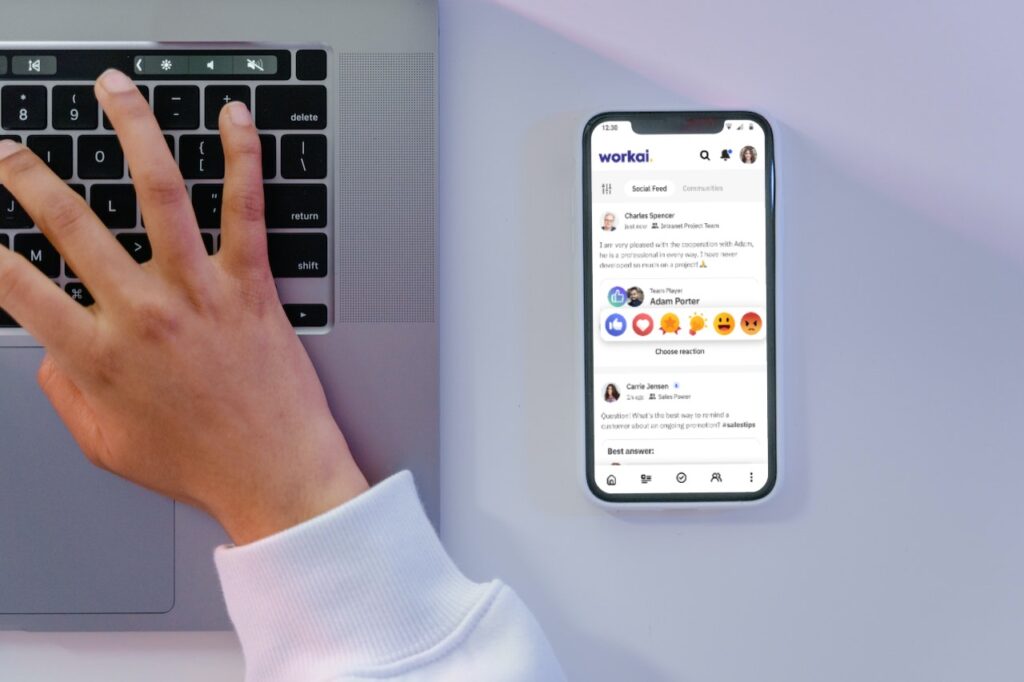
Technology significantly facilitates this model: platforms like WORKAI® enable organisations to publish strategic messages and collect feedback in one place, ensuring organised, transparent, and consistent information management. As a result, organisations can successfully combine both communication approaches and build a modern, engaging communication system.
How to measure the effectiveness of top-down and bottom-up communication
Measuring the effectiveness of organisational communication is only possible when data is analysed regularly and the impact of actions taken within both models is carefully observed. Because top-down and bottom-up communication serve different purposes, each requires its own set of indicators. Monitoring these metrics consistently helps organisations understand how information flows, identify gaps, and adjust communication strategies to employees’ real needs and changing organisational conditions.
In top-down communication, the key question is whether employees actually receive and understand the information shared with them, and whether they act on it. This makes it essential to analyse communication reach—for example, how many people opened, read, or viewed a message—along with reaction time, which shows how quickly teams implement instructions or changes. Another important factor is message comprehension, measured through short surveys or quick tests. Equally significant is organisational alignment, which indicates whether teams carry out tasks in accordance with the instructions they receive. Platforms like WORKAI® support this process by providing detailed analytics such as read confirmations and activity statistics.
Bottom-up communication, on the other hand, focuses on employee engagement, so its effectiveness is primarily reflected in the number and quality of ideas, comments, and feedback submitted. Participation levels in surveys, Q&A sessions, workshops, or idea boards are strong indicators of how encouraged employees feel to engage in dialogue. It is also important to measure how quickly the organisation responds to bottom-up input—rapid analysis and implementation strengthen employees’ sense of influence. The impact of employee suggestions on business outcomes, such as process improvements, cost reductions, or efficiency gains, should also be taken into account. WORKAI® simplifies this analysis by organising feedback in one place, allowing organisations to identify recurring themes or needs emerging from employee conversations.
The most complete picture of communication effectiveness is obtained when data from both models is analysed together. This helps reveal correlations that would otherwise go unnoticed—for instance, whether consistent top-down communication increases bottom-up participation, or whether employee-generated ideas support better execution of strategic initiatives. Comparing insights from both communication streams also helps identify bottlenecks and determine which actions need improvement.
Regular measurement is essential, because without data, communication relies largely on intuition. Systematic analysis helps eliminate ineffective practices, supports evidence-based decision-making, improves message quality, and strengthens a culture of transparency. Combined with technologies such as WORKAI®, measurement becomes a natural, repeatable part of everyday organisational operations—continuous, structured, and directly contributing to better work outcomes.

The most common mistakes in top-down and bottom-up communication, and how to avoid them
Even a well-designed communication strategy can lose effectiveness if an organisation begins to repeat typical mistakes. Both top-down and bottom-up communication come with risks that can weaken trust, slow processes, or create informational chaos. Understanding these pitfalls helps organisations respond quickly and build a stable, predictable communication system that supports business goals.
Mistakes typical of top-down communication
Vague or overly general messages
When information is delivered without context or in an unclear form, employees struggle to interpret it, and task execution becomes inconsistent.
How to avoid it: Formulate messages based on concrete objectives and expected outcomes, supplementing them with short summaries or Q&A sections that clarify the most important points.
Too little space for questions
Top-down communication does not have to be strictly one-way, but applying it too rigidly leads to misunderstandings and lowers team trust.
Solution: Regular Q&A sessions, surveys, or dedicated channels for asking questions help clarify doubts and strengthen transparency. Tools like WORKAI® can support this by collecting questions and publishing answers in a central place..
Irregular communication
When information appears rarely or unpredictably, employees begin to rely on assumptions, which encourages misinformation.
How to prevent it: Establish a consistent communication rhythm—weekly updates, regular summaries, or scheduled strategic announcements help maintain clarity and predictability.
Mistakes typical of bottom-Up communication
Collecting ideas without follow-up
Nothing undermines engagement more quickly than the sense that feedback disappears into a void.
How to avoid it: Inform employees which suggestions were implemented, considered, or rejected—and if rejected, explain why. Transparency builds a sense of influence.
Lack of structure and priorities in handling feedback
If feedback flows into many places or is not filtered, the organisation quickly loses control of the process.
Solution: Use clear channels for collecting input, such as idea boards or categorised submission forms. WORKAI® enables structured moderation and organised analysis of employee feedback.
Over-reliance on employee initiative
Not every employee willingly shares ideas, even if they have valuable observations.
How to address it: Encourage bottom-up communication by inviting teams to share opinions on specific topics or by initiating areas where input is needed.
Mistakes common to both communication models
Inconsistent messaging across channels
If messages are not coordinated, employees may receive conflicting information, which weakens trust and leads to operational errors.
How to avoid it: Centralise knowledge, for example, in an intranet, to keep content organised and up to date.
Lack of data analysis and insights
Without monitoring key metrics, communication becomes intuitive and difficult to improve.
Solution: Regularly analyse data on message open rates, employee activity, the number of submissions, or survey results to support fact-based decision-making.
Misalignment between the communication model and organisational culture
Even the best practices will not work if the communication style does not match the organisation’s values and ways of working.
How to avoid it: Before implementing a model, assess trust levels, leadership style, organisational structure, and employees’ readiness for more autonomy or more formal processes.
Why avoiding these mistakes matters
Systematically identifying and eliminating communication mistakes helps improve information flow, increase employee engagement, and accelerate decision-making. Moreover, maintaining communication quality strengthens organisational culture by building trust and a sense of shared responsibility—regardless of whether the dominant model is top-down, bottom-up, or hybrid.

Choosing between top-down and bottom-up communication often raises many questions, especially when an organisation wants to improve information flow, employee engagement, or decision-making speed. Below are answers to the most frequently asked questions about the differences between these models, along with practical tips to help you decide which approach may work best for your company.
Can the disadvantages of top-down communication also be advantages of bottom-up communication?
Yes, the disadvantages of top-down communication can simultaneously be advantages of bottom-up communication, because the two models work in opposite ways. Top-down communication often limits feedback and dialogue—elements that become key strengths in a bottom-up approach, where employees are encouraged to share ideas, opinions, and concerns. On the other hand, bottom-up communication can be slower and less structured, which highlights the strengths of top-down communication, such as fast decision-making and a clear communication structure.
How can a company reduce the risks associated with implementing top-down communication?
The most effective way to reduce the risks of top-down communication is to complement it with regular feedback channels, such as surveys, Q&A sessions, employee meetings, or platforms for submitting questions. This keeps communication hierarchical while still enabling two-way dialogue – employees can express their opinions, and leadership gains access to insights that support more informed decision-making.
How can an organisation avoid information chaos in bottom-up communication?
To avoid chaos in bottom-up communication, it is essential to introduce clear rules for submitting information and to use tools that help manage a large volume of input. Good practices include establishing dedicated channels (such as an intranet or structured feedback forms) and applying moderation and prioritisation when reviewing ideas. This ensures bottom-up communication remains organised and contributes meaningfully to decision-making instead of slowing it down.
Is it possible to completely eliminate the disadvantages of top-down and bottom-up communication?
No, completely eliminating the disadvantages of both models is not possible, because their limitations stem from their fundamental characteristics. However, these weaknesses can be significantly reduced by using a hybrid approach that combines the clarity and speed of top-down communication with the engagement and openness of bottom-up communication. In practice, this allows organisations to benefit from the strengths of both models while minimising their drawbacks.