



Managing Internal Communication in 2026
Just a few years ago, internal communication in many organizations could be reduced to one question: where should we publish this information? Today, the question sounds very different: how do we ensure it is noticed, understood, and does not disappear in the noise?
The role of the internal communication editor has evolved. From someone publishing news updates, they have become a content curator, campaign planner, and guardian of message consistency. Managing internal communication in 2026 requires not only publishing content, but actively shaping how, when, and why it reaches employees. With this shift, expectations toward tools have increased, not only those that enable publishing, but those that genuinely support everyday editorial decision-making.
The ClearBox Intranet and Employee Experience Platforms 2026 report shows that the internal communication technology market has reached a certain level of maturity. Differences between platforms less frequently concern core functionality and more often reflect a philosophy of working with content, analytics, and employee attention. It is in this area that the distinct approaches of Workai, Staffbase, Interact, and the Microsoft Viva ecosystem built on SharePoint become most visible.
The editor’s architecture of work: studio or distributed ecosystem?
The way a platform structures the editor’s workflow has a direct impact on communication quality and long-term effectiveness. This is not a cosmetic difference, but a decision about where editorial decisions are made and how easily they can be managed.
Within the Microsoft ecosystem, content creation is relatively simple, but responsibility for communication is spread across multiple applications, such as SharePoint, Viva Amplify, Viva Engage, and Teams. In practice, planning, publishing, and analytics live in separate environments. For editors, this translates into the risk of inconsistent campaigns, difficulty assessing real communication impact, and the need to manually consolidate data from multiple sources..
Standalone platforms such as Staffbase or Interact address this issue by offering a single, comprehensive communication management center. The benefit is full control over campaigns and message consistency; the trade-off is interface complexity and greater organizational demands, particularly in smaller editorial teams.
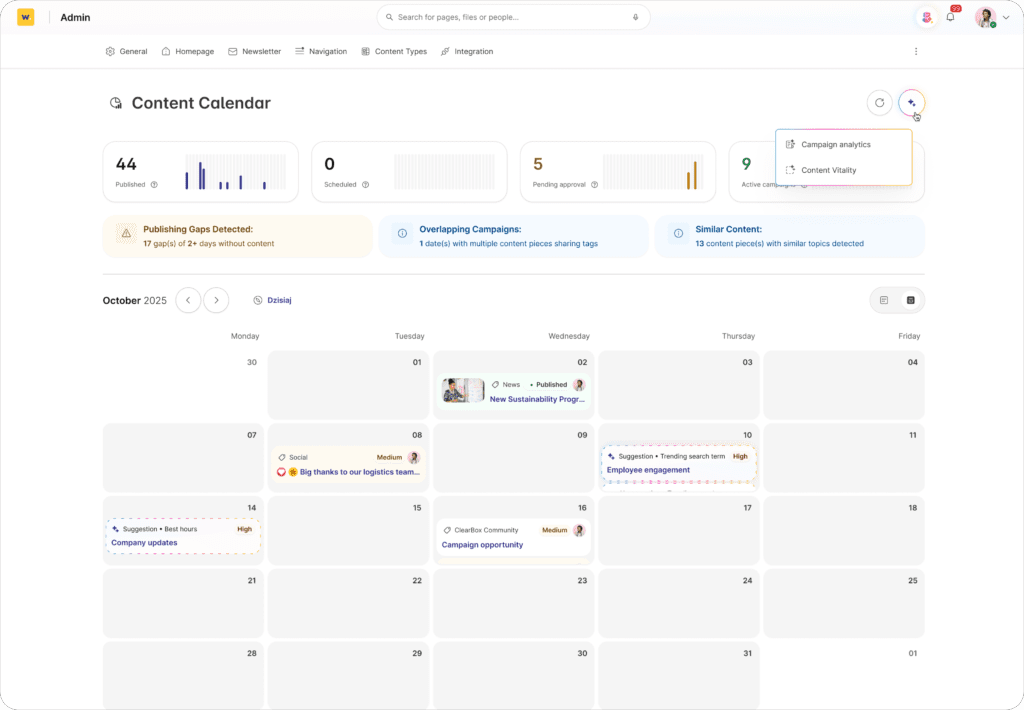
Against this backdrop, Workai adopts a middle-ground approach. Instead of one heavy “studio,” it provides a modular work environment where editors use only the tools required at a given stage: planning, publishing, quality assessment, or distribution. The result is lower cognitive load, shorter decision-making time, and reduced risk that editorial work turns into system administration rather than communication management.
ClearBox experts describe Workai as a versatile and highly modular product that offers many attractive features and will appeal to a wide range of organisations.
Content creation: editor or editorial quality control system?
At the level of content editing itself, differences between mature platforms are becoming increasingly small. Interact continues to develop its advanced Block Editor, offering significant flexibility in structuring articles, while Staffbase enhances cross-department collaboration through its Briefings feature, enabling draft collection for further editorial refinement. These solutions genuinely accelerate content creation.
At the same time, this working model carries a specific risk: communication quality remains largely dependent on the experience and attentiveness of individual editors. Maintaining language consistency, inclusivity, and tone alignment across different employee groups is difficult to achieve at scale through manual control alone.
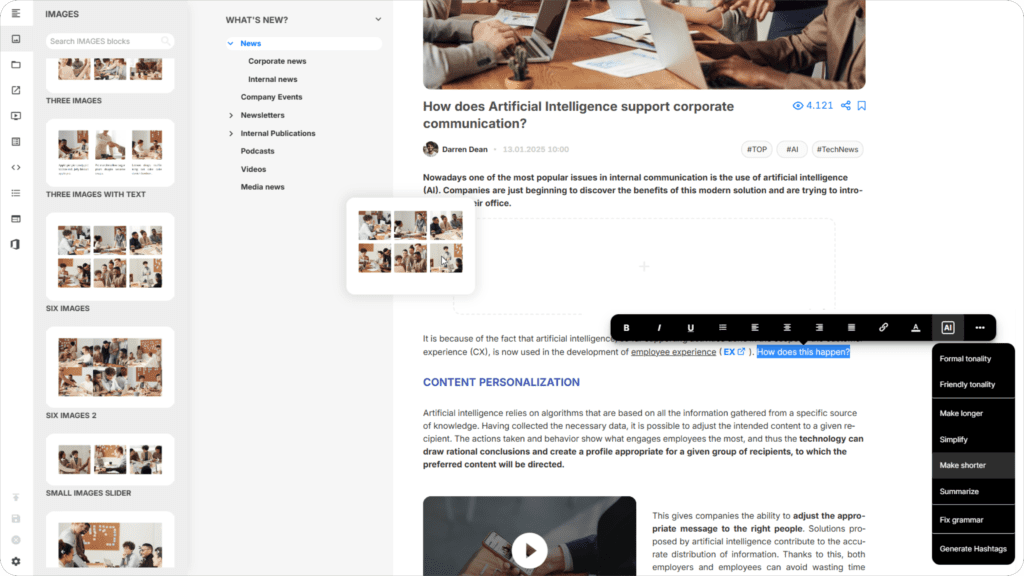
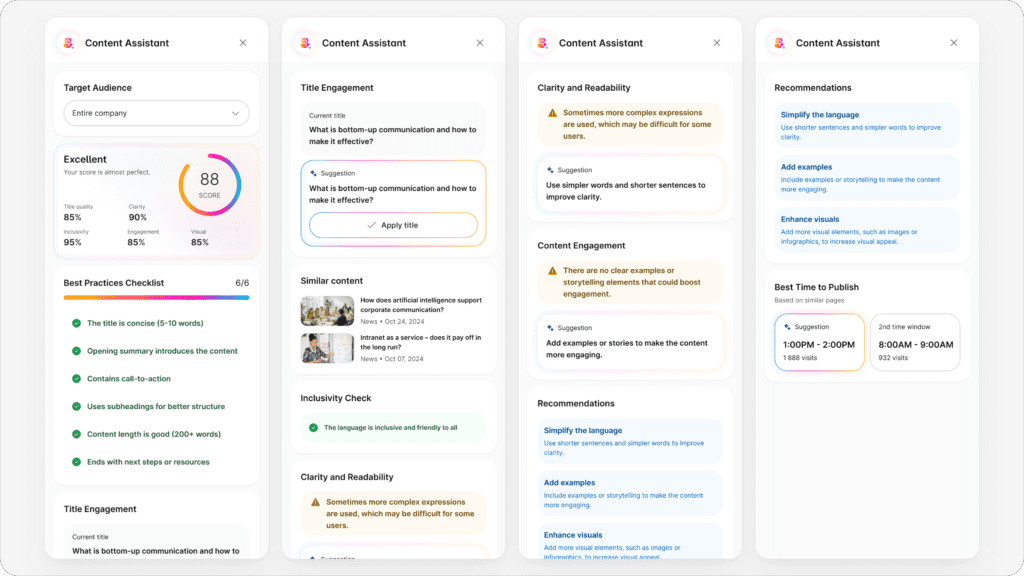
Workai shifts the center of gravity from writing itself to communication quality management. Its AI Content Assistant acts as an editorial auditor, analyzing content for readability, inclusivity, and alignment with internal communication standards, while also recommending optimal publication timing. In practice, this provides systemic support in areas previously governed by intuition or the time available for manual review.
ClearBox Report: We found the AI Assistant very valuable and can clearly see how it will improve the effectiveness of internal communication. The Assistant calculates a quality score for the article based on elements such as a configurable best practices checklist, an inclusivity check, and suggestions for clarity and readability.
For organizations, this translates into a tangible benefit: communication ceases to be the sum of individual editorial decisions and instead functions as a coherent, measurable process in which quality is not accidental, but centrally managed. This marks a fundamental difference between a writing tool and a platform that genuinely supports building a communication culture at scale.
Campaign management and the fight for attention: analytics or traffic control?
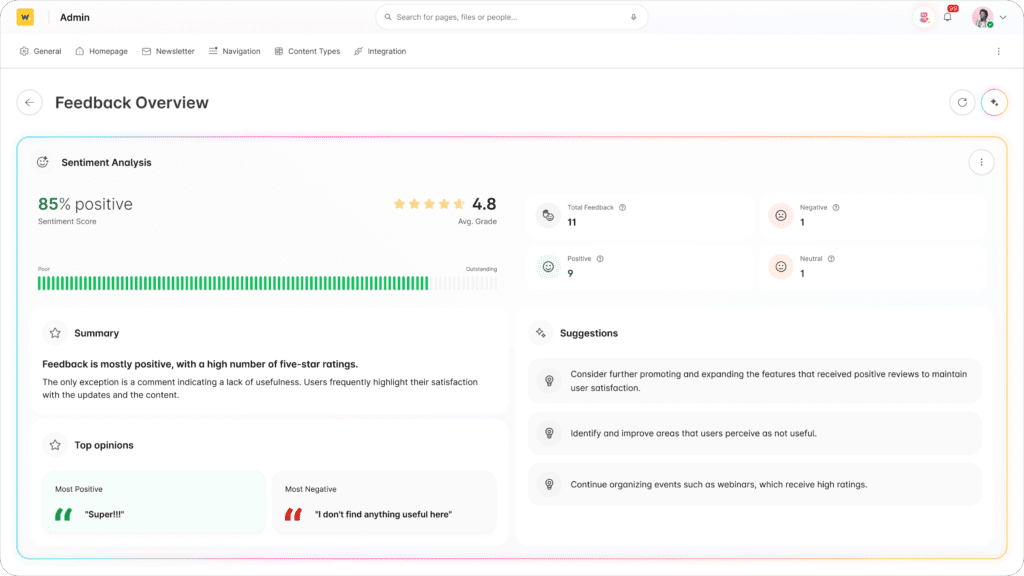
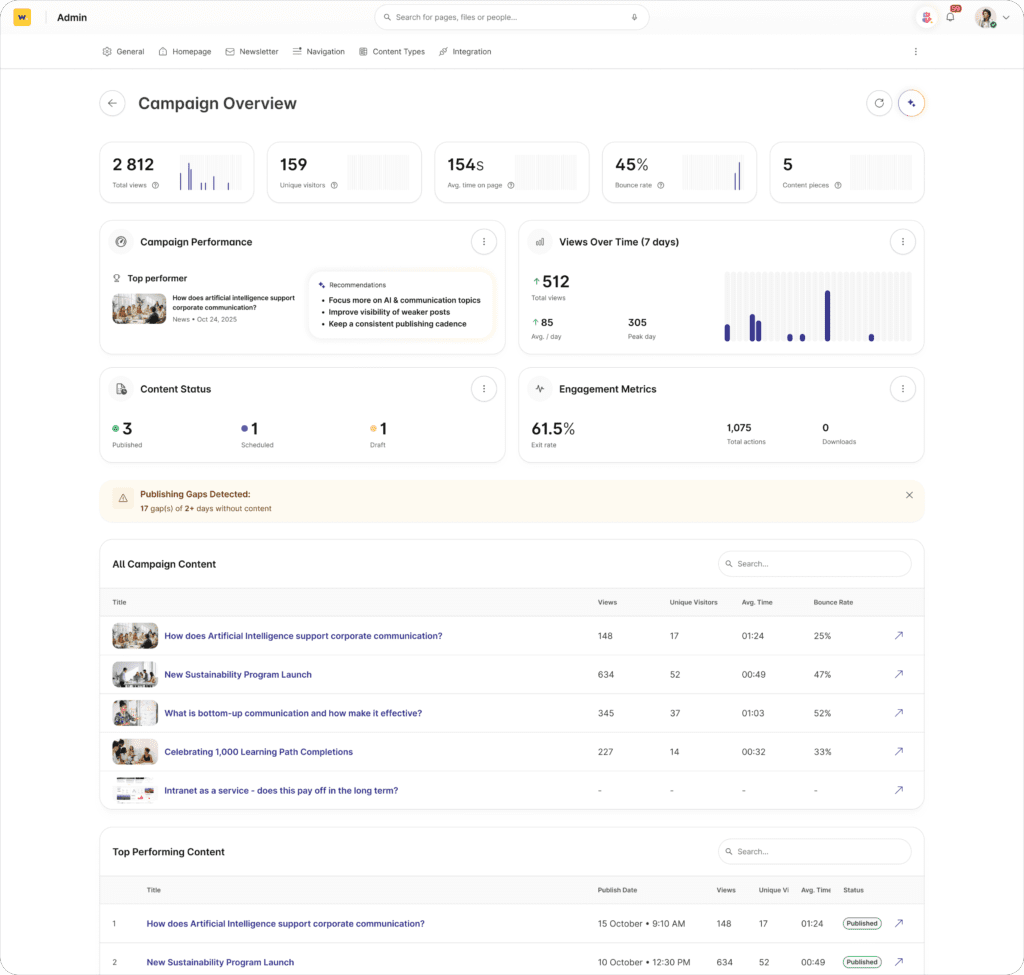
One of the biggest challenges in internal communication in 2026 is not the lack of content, but its excess. The ClearBox report notes that while many platforms offer basic reach and engagement metrics, campaign analytics rarely help editors answer a key question: can the organization realistically absorb this communication at this moment?
Solutions such as Staffbase provide advanced data on campaign comprehension and alignment with organizational objectives. This offers valuable retrospective insight, but in practice, it means conclusions emerge after the fact – when employees are already overloaded, and attention has been fragmented.
Workai approaches this area from a different angle. Instead of measuring outcomes alone, it seeks to prevent the problem at the planning stage. The “Content Vitality” dashboard and intelligent content calendar analyze planned communication, identifying overlapping campaigns, recurring themes, and the risk of information overload. The system can recommend adjustments before publication, shifting dates, merging messages, or recalibrating emphasis.
ClearBox experts: We like the innovative ‘Content Vitality’ dashboard where content is analysed for freshness and reach of intended audiences, with AI-generated improvement suggestions.
For editors, this represents a fundamental shift in the role of the tool. Rather than reacting to declining engagement and communication fatigue, they receive real-time strategic support. The platform stops being a passive content repository and begins functioning as information traffic control, protecting employee attention as one of the organization’s most valuable resources.
Multichannel distribution: reach or real accessibility?
On paper, most internal communication platforms today offer multichannel capabilities: newsletters, mobile apps, digital signage. In practice, however, differences become visible only when communication must reach employees working in varied conditions and with limited attention.
Platforms such as Interact stand out with strong digital signage and employee advocacy capabilities, which work well in brand-driven campaigns. Staffbase and the Microsoft Viva ecosystem expand distribution within their own toolsets, offering broad reach but often requiring editors to manually adapt content for individual channels.
This approach carries a specific risk: the same message begins to exist in multiple versions, published at different times and with varying visibility levels. As a result, editors lose control over what actually reaches employees, and communication becomes uneven, especially in organizations with a large frontline workforce.
Workai approaches distribution differently. Rather than treating channels as separate entities, it prioritizes automation and experience consistency. An advanced newsletter builder with automated digests, combined with audio functionality, allows content to be delivered in formats adapted to the work context, including moments when employees are on the move or unable to focus on a screen.
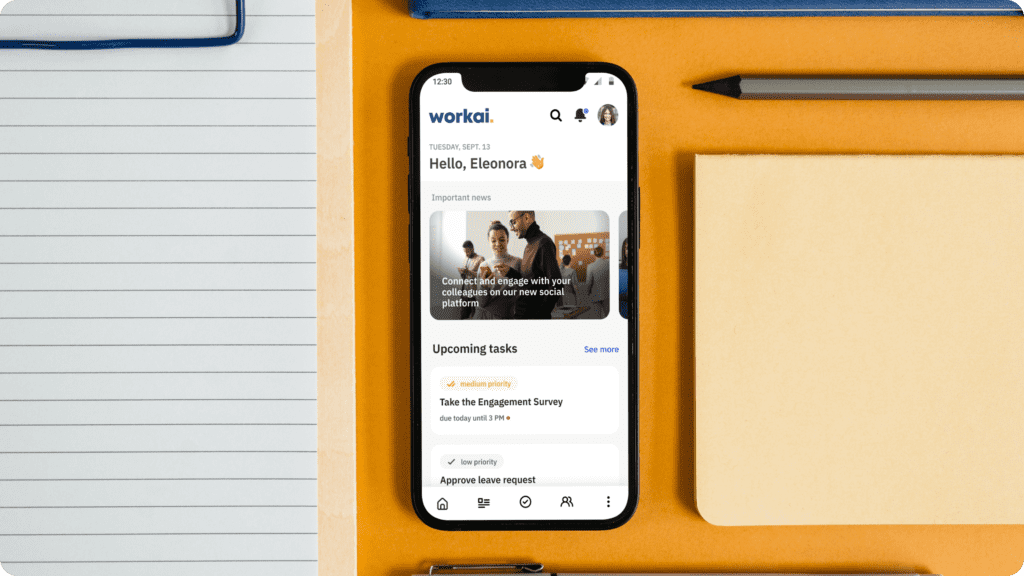
Particularly important is the approach to mobile. In many solutions, the mobile app remains an extension of the desktop environment. In Workai, it functions as an equal work environment — critical in organizations where the smartphone is the primary point of contact with the company. In practice, this means not only broader communication reach, but a significantly higher chance that information is actually noticed and absorbed.
Internal communication rarely fails spectacularly. More often, it loses meaning when employees can no longer distinguish what is important from what is simply another update. When editors spend more time planning, reporting, and “managing the system” than working with content and communication intent.
The ClearBox report shows that by 2026, internal communication tools will be technologically mature. The differences between them do not lie in whether they can perform certain functions, but in how effectively they help people make sound communication decisions in everyday work. Do they organize chaos, or merely measure it? Do they support quality, or only scale?
ClearBox report: Workai offers rich functionality to meet most needs of internal communicators and editorial teams (…). We like the power and intuitiveness of the Block Editor, and especially the helpful integration of AI in the content creation process and the editorial calendar.
From this perspective, choosing a platform is no longer a decision about the “most feature-rich solution.” It becomes a choice about the role communication should play within the organization: whether it will react to information overload or prevent it; whether it will remain a collection of individual publications or become a coherent, managed process.
In a world where employee attention is increasingly difficult to reclaim, the greatest value lies in tools that do not try to speak louder than others, but help organizations communicate more thoughtfully, less frequently, and at the right moment. And this is precisely the direction that emerges most clearly from the analysis of the internal communication market in 2026.