



ClearBox report 2026: Knowledge management in the digital workplace
Just a few years ago, managing knowledge management in the digital workplace looked similar in most organizations. A “Documents” section was created, procedures and policies were uploaded, and within a few months, no one was entirely sure which version was current. Employees asked each other on Teams instead of searching the system, and the intranet increasingly became an archive rather than a real support tool for daily work.
It was precisely this gap between “knowledge stored” and “knowledge used” that led the ClearBox Intranet and Employee Experience Platforms 2026 report to separate Knowledge Management into a dedicated evaluation scenario for the first time. Analysts note that knowledge is no longer an extension of communication – it has become one of the core pillars of the digital workplace and one of the most complex areas to design effectively.
ClearBox does not hide the fact that the Knowledge Management market is still maturing. Lower average scores reflect everyday organizational challenges: content that quickly becomes outdated, information that is difficult to find, and systems that fail to support employees in making decisions in real time. Against this backdrop, Workai stands out with an approach that redefines the role of the intranet — not as a document repository, but as an intelligent system of action where knowledge actively supports daily work rather than merely “existing somewhere.”
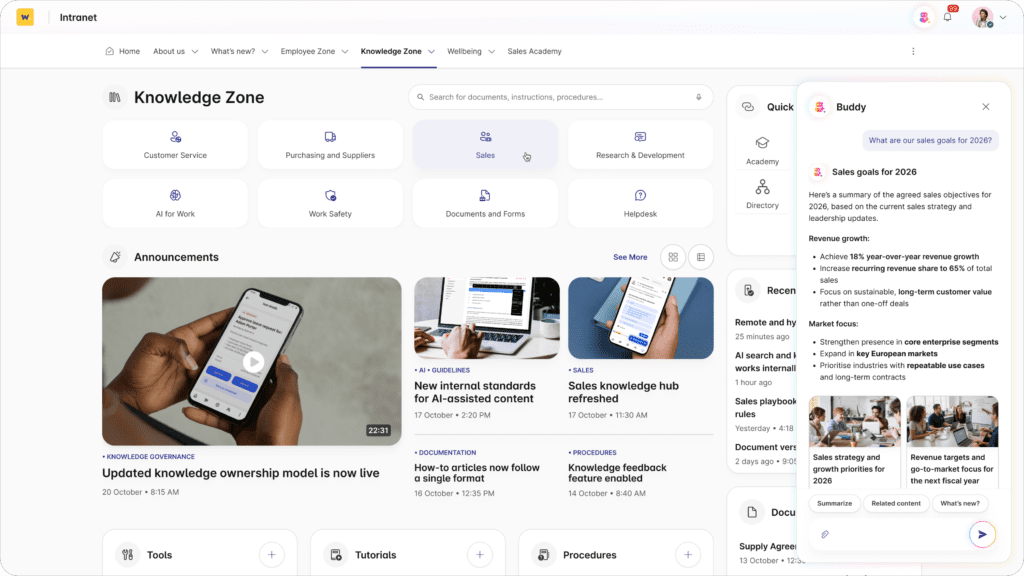
ClearBox experts emphasise that the AI assistant will only use company information and respects user permissions, so content is not used where an employee does not have access.
Workai compared to market leaders
The ClearBox 2026 report shows that in the Knowledge Management domain, there is no single dominant model. Atlas focuses on rigorous structure and taxonomy, Interact on advanced administrative processes, Omnia on formal document governance, MangoApps on community-driven activity, and Microsoft on infrastructure-level integration within M365.
Workai positions itself between these approaches, but with a clear priority: usability over architectural complexity. Rather than maximizing structural sophistication or process layers, it concentrates on automation, content freshness, and shortening the distance between question and answer.
Workai vs. Atlas
Atlas is described in the ClearBox report as a solution for “information-rich” organizations — those with extensive content repositories and the willingness to invest significant resources into organizing them. However, the platform requires carefully designed taxonomies and long-term commitment to knowledge architecture.
Workai represents a different approach. Instead of expecting employees to become “guardians of structure,” the platform relies on automation and content vitality analysis. The unique Content Vitality dashboard monitors freshness, reach, and article usage, while AI recommends which materials require updates or restructuring. As a result, knowledge remains usable without months of workshops dedicated to metadata frameworks. Workai is a ready-to-go solution designed to deliver precise answers here and now.
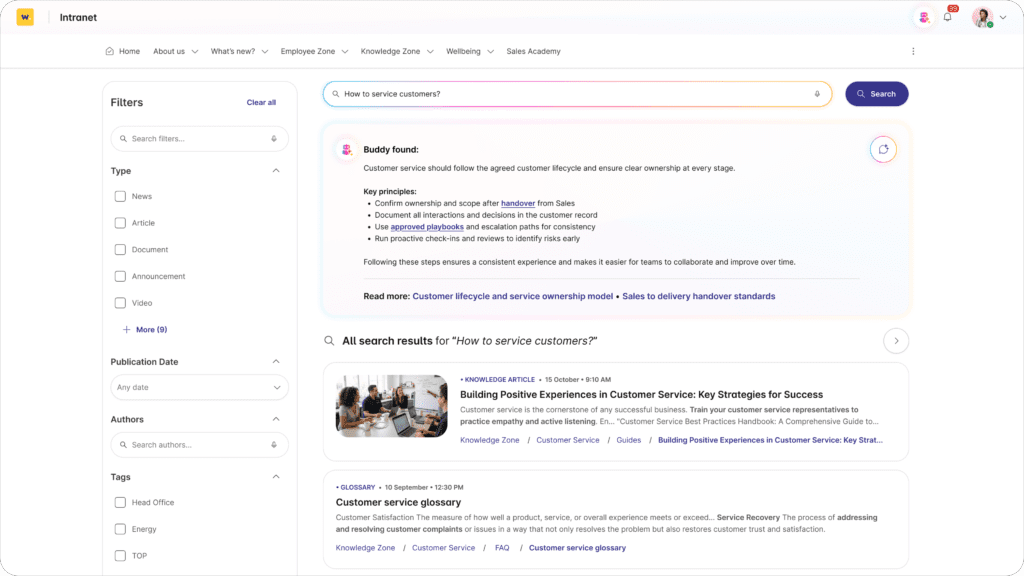
ClearBox notes that knowledge is made more digestible for employees through AI. Across the platform, an AI-powered “Summarise” icon appears next to the titles of articles and other content types, enabling users to quickly grasp key information.
Workai vs. Interact
Interact stands out with mature administrative capabilities, particularly in large-scale content management. Features such as bulk page ownership changes and comprehensive lifecycle management processes are highly valued in complex editorial environments.
Workai, however, focuses on the end-user perspective. Instead of advanced administrative workflows, it provides AI-native summaries for every article, automatic topic tagging, and contextual linking between related knowledge areas. As a result, knowledge in Workai “finds itself,” and employees do not need to understand the intranet’s structure to locate the right information.
Workai vs. Omnia
Omnia emphasizes “Official Documents” governance and multi-stage approval workflows, making it a strong choice for regulated organizations. However, this approach often reinforces the perception of knowledge as a document archive rather than a practical tool.
Workai offers a more flexible Knowledge Zone model. Thanks to its modular structure and dedicated templates (for example, for procurement or customer service teams), knowledge is presented in a modern accordion-style layout with built-in FAQs and contextual search. This model better reflects real user needs than traditional SharePoint document libraries.
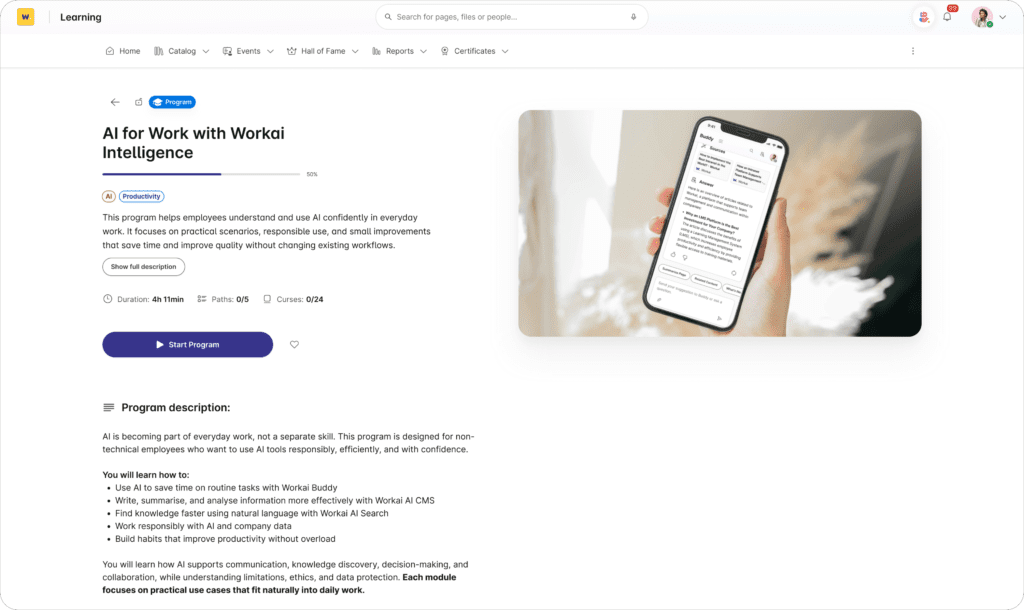
The ClearBox report recognises the innovative ‘Content Vitality’ dashboard where content is analysed for freshness and reach of intended audiences, with AI-generated improvement suggestions.
Workai vs. MangoApps
MangoApps focuses on “Verified Content” and crowdsourced Q&A. This community-driven model works well in dynamic organizations.
Workai takes this further with Workai Buddy. The AI assistant does not merely answer questions – it understands intent. A query such as “who is responsible for marketing?” does not trigger a document search but instead delivers a context-aware response based on organizational structure. In this way, Workai acts as a true AI-powered front door to company knowledge.
Workai vs. Microsoft
For many organizations, Knowledge Management begins with the standard Microsoft 365 ecosystem. SharePoint provides document libraries, informational pages, and basic search capabilities. In theory, everything needed is already there.
In practice, ClearBox 2026 shows that the challenge is not missing features but fragmentation and the absence of a cohesive Knowledge Management layer. Knowledge within Microsoft 365 is often scattered across SharePoint, Teams, Viva Engage, and OneDrive. Each component has its own storage logic and permissions structure. Users must know where to look – the system rarely guides them contextually.
Workai operates as a consistent layer above Microsoft 365 content, integrating data through APIs without interfering with its structure. Instead of another document library, it offers a dedicated Knowledge module with AI-native summaries, content vitality monitoring, and conversational access through Workai Buddy.
The difference is simple: in the Microsoft model, knowledge exists “where it was stored.” In the Workai model, knowledge appears “where it is needed.”
The ClearBox 2026 analysis shows that the biggest problem in Knowledge Management today is not the lack of content. The problem is that knowledge rarely supports employees when it is truly needed. Documents are long, fragmented, and quickly outdated, and the intranet often complicates work instead of simplifying it.
This is where Workai’s approach begins to clearly diverge from most market solutions. The platform does not attempt to win the race for the “largest archive,” but instead focuses on making knowledge understandable, current, and actionable in everyday work.
The first pillar of this approach is AI-native summarization. The Summarise feature, available for every article, enables employees to grasp even complex procedures within seconds. Instead of navigating lengthy documents, they receive the essence of information precisely when they need it.
The second element is the Content Vitality dashboard, which changes how organizations perceive their knowledge base. Instead of a static document repository, companies gain a tool for monitoring content “health” — freshness, reach, and actual usefulness. This capability, absent even in some higher-scoring platforms in the ClearBox report, often determines whether knowledge remains alive or gradually loses relevance.
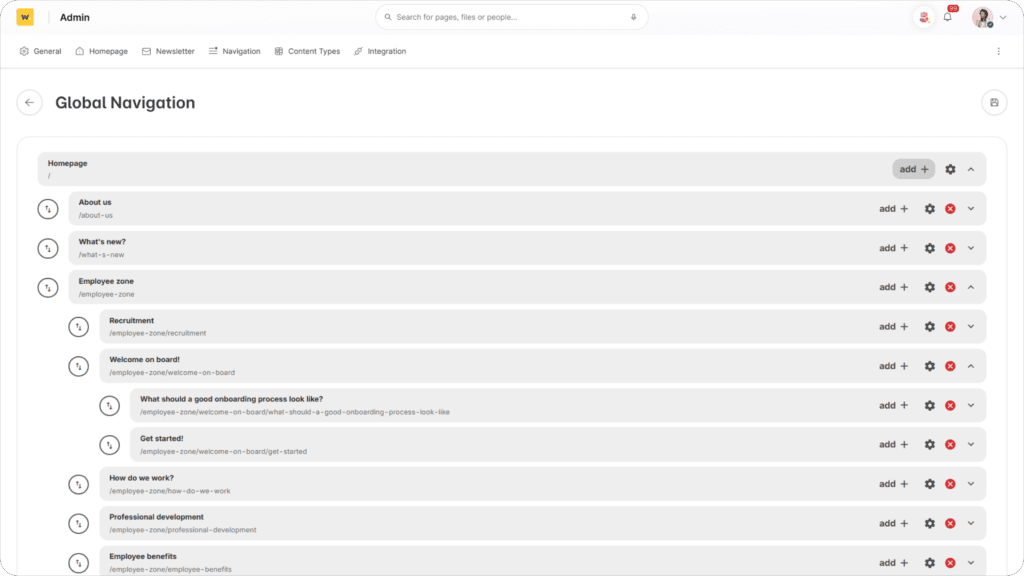
The third differentiator is modularity. Workai enables the creation of dedicated knowledge zones, for example, for frontline employees, each with its own branding, structure, and contextual search. Knowledge is no longer “one-size-fits-all,” but tailored to the real needs of different employee groups.
As a result, with its Workai Knowledge module, the platform does not position itself as another document management system, but as a balanced Knowledge Management solution combining AI potential with operational simplicity. For organizations seeking to structure knowledge without falling into the trap of complex architectures and lengthy implementation projects, this approach in 2026 proves to be not only modern, but above all pragmatic.