


How to create an effective company newsletter: 6 formats and best practices
It’s Monday morning. Between a message from a colleague and yet another meeting invitation, a company newsletter lands in an employee’s inbox. They open it, scan the first few lines and, seconds later, go back to whatever they were doing. Important information has just lost the battle for their attention. So what makes employees stop, keep reading and actually take action?
A company newsletter can be one of the most useful tools in internal communication. It can bring important updates together, promote events and training opportunities, support knowledge sharing and help employees stay connected with what is happening across the organization.
But simply sending a newsletter does not mean people will read it.
Its effectiveness depends not only on what you communicate, but also on how you present it. A good company newsletter should have a clear purpose, an easy-to-follow structure and a natural path that leads employees towards the most important information or action.
Below, we look at the key principles behind an effective employee newsletter and six formats you can use depending on what you want your communication to achieve.
Why don’t employees read company newsletters?
The problem is often not a lack of valuable information. It is the opposite: there is simply too much of it.
One newsletter may contain updates from several departments, HR announcements, upcoming events, new procedures, business results and learning opportunities. Everything feels important, so everything gets a similar amount of space.
As a result, nothing really stands out.
Another common issue is a lack of information hierarchy. Long paragraphs, multiple visuals and several equally prominent calls to action make it difficult for employees to quickly understand what matters most.
And most people do not read a company newsletter from the first sentence to the last. They scan it first, looking for something relevant to them.
A well-designed newsletter should therefore make three things immediately clear: what the message is about, which information matters most to the reader and what they should do next.
What makes a good company newsletter?
There is no single newsletter format that will work for every type of internal communication. A weekly roundup needs a different structure from a training announcement. A company results update should look different from a newsletter focused on culture or upcoming events.
There are, however, a few principles worth applying regardless of the format.
Start with one clear objective
A newsletter may contain several pieces of information, but it should still have one primary purpose. That might be encouraging employees to register for an event, directing them to new intranet content, promoting a development programme or highlighting the organization’s latest achievements.
Defining that objective first makes it much easier to decide what belongs in the newsletter — and what does not.
Create a clear information hierarchy
The most important message should be visible immediately.
A strong headline, short introduction and prominent visual can help employees understand the topic before they begin reading in detail. The following sections should then guide them naturally from the main message to supporting information.
Make the next step obvious
A call to action should tell employees exactly what will happen after they click.
Instead of a generic “Learn more”, consider more specific CTAs such as:
- See all updates
- View the training programme
- Register for the event
- Read the full report
- Share your feedback
The less effort required to understand the next step, the more intuitive the newsletter becomes.
Make content easy to scan
Short paragraphs, descriptive headings, visuals, key figures and clearly separated sections allow readers to find relevant information without reading every word.
A newsletter does not always need to contain the full story. In many cases, its role is to create interest and guide employees towards the complete content available on the intranet.
6 company newsletter ideas you can use
1. Weekly or monthly roundup
This is one of the most versatile company newsletter formats.
It gives employees one place to catch up on important updates, recently published content and upcoming events without having to search for them individually.
Start with a short overview of what happened during the week or month. Employees should immediately understand which topics are covered before moving further down the newsletter.
You can then highlight the latest news, selected articles and upcoming activities.
Dynamic content lists can make this process much easier. In Workai, for example, they can automatically display content published within a selected period or associated with specific tags. This helps keep the newsletter up to date without manually adding every piece of content each time.
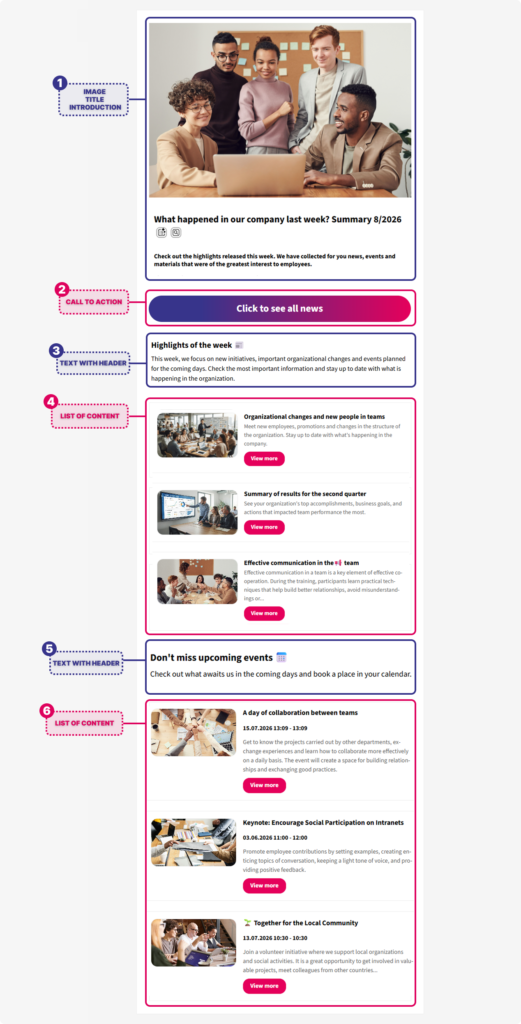
A simple structure could include an opening visual and introduction, a short weekly summary, recent updates, upcoming events, and one or two initiatives you want to give additional visibility.
Example structure:
- Visual, headline, and a short introduction.
- Button linking to all company updates.
- Brief summary of the most important topics.
- List of the latest posts.
- Preview of upcoming events.
- Highlighted events or initiatives.
This format works well as a weekly or monthly roundup of what’s happening across the company.
2. Culture and employee development
Not every company newsletter has to focus on corporate announcements.
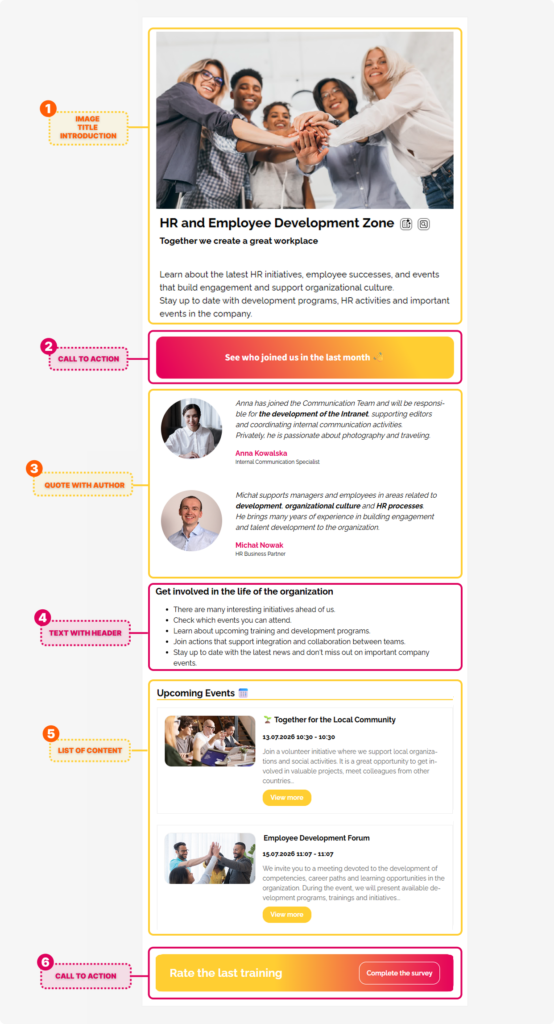
A newsletter dedicated to organizational culture can introduce new employees, celebrate promotions, communicate team changes and highlight HR or development initiatives.
Its role is not only to inform, but also to help employees understand what is happening across the organization and get to know the people behind different teams.
This format can also be used to promote learning opportunities, internal programmes and company initiatives. Adding a feedback form makes it easier to collect employees’ opinions after an event, training session or internal campaign.
Example structure:
- Introduction to the main topic.
- Presentation of a new HR initiative.
- New employees, promotions, or team changes.
- Invitation to take part in company initiatives.
- List of training sessions and events.
- Button linking to a feedback form.
This format works well as a weekly or monthly roundup of what’s happening across the company.
3. Best practices and inspiration
A company newsletter can also become a useful knowledge-sharing tool.
Instead of focusing only on announcements, dedicate an edition to a particular topic and use it to share practical tips, lessons learned and examples from across the organization.
The topic could be anything from project management or cybersecurity to customer service, collaboration or using AI at work.
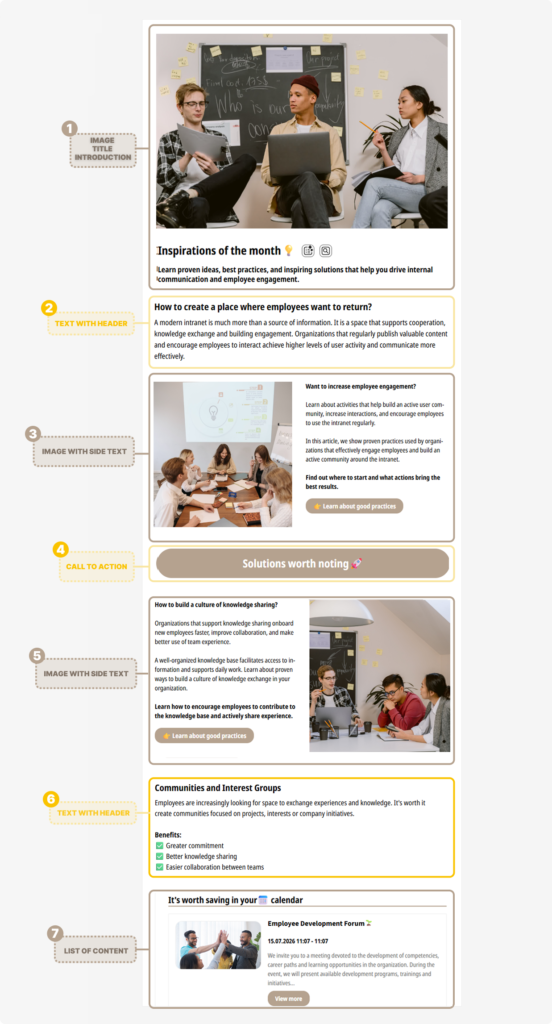
Start with one central idea and develop it through a few short sections. Combine concise content with visuals and direct employees to longer articles or related resources when they want to explore the topic in more detail.
You can also highlight a real example of how a team applied a particular practice. This helps move the newsletter away from abstract recommendations and towards knowledge employees can actually use.
Example structure:
- Main topic and a short introduction.
- Key best practice or practical tip.
- Example of how it can be applied within the organization.
- Link to the full article or resource.
- List of the key benefits.
- Recommended resources.
- Related event or webinar.
4. Training and employee learning
Announcing that a new training course is available is rarely enough to generate interest.
Employees first need to understand why it might be useful to them.
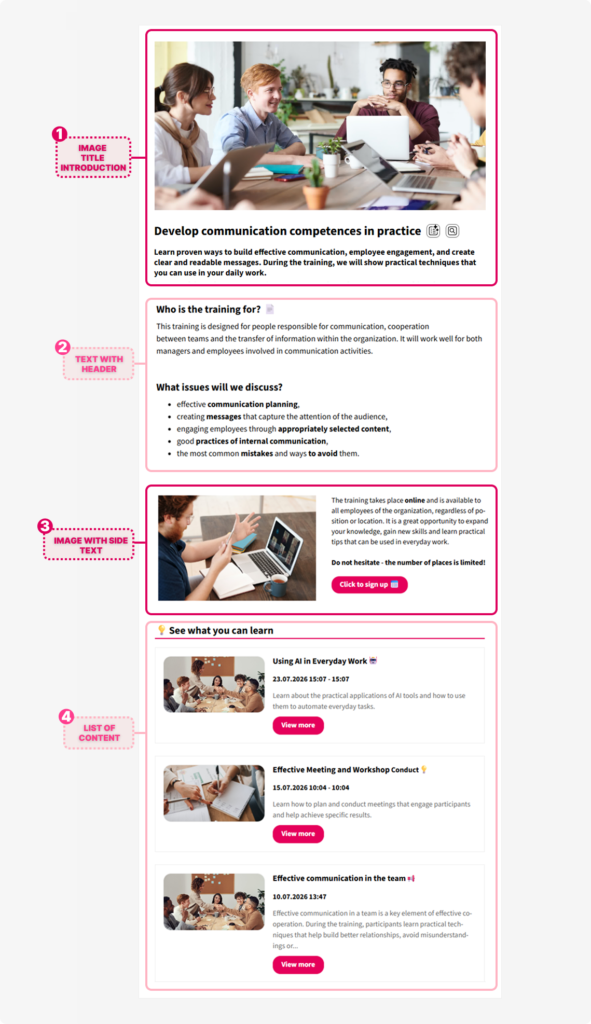
A training-focused newsletter should quickly answer a few questions: What will I learn? Who is it for? How much time will it take? Who is running it? And how do I join?
Presenting the programme and target audience clearly helps employees decide whether the training is relevant to them. A visible CTA leading directly to registration also shortens the journey between interest and action.
Instead of saying only: “New training available” try framing it around the value for the employee: “Want to get better at presenting your ideas? Join our 60-minute practical session.“
The difference is small, but the second version gives the reader a reason to keep going.
Example structure:
- Training title and key benefit.
- Information on who the training is for.
- Scope and key topics covered.
- Trainer, date, and session format.
- “Register now” button.
- Recommended resources or additional training opportunities.
5. Company achievements and results
Communicating business results internally can easily turn into a wall of numbers. It does not have to.
A company newsletter gives you the opportunity to translate results into a story employees can quickly understand.
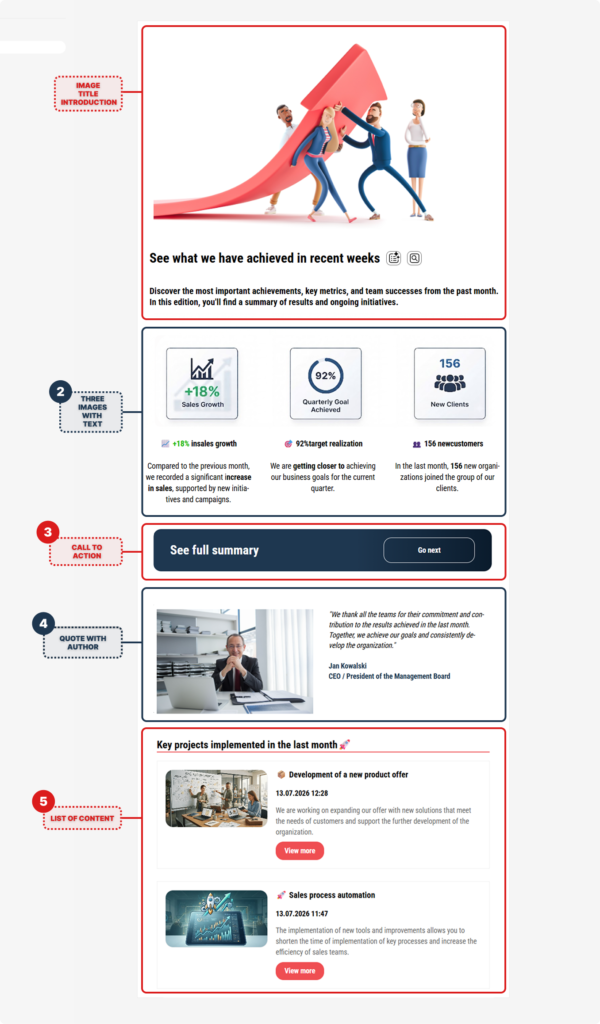
Highlight the most meaningful figures, explain what they mean and show the projects or teams that contributed to them. Visuals and key metrics can make the information easier to digest, while a short comment from a leader or expert can provide additional context.
This is also a good moment to recognize the people behind the results.Instead of simply communicating what the organization achieved, show how it happened and who helped make it possible.
Example structure:
- Key achievement from the period.
- Key figures and metrics.
- Link to the full summary.
- Comment from a leader.
- Most important projects and initiatives.
- Thank-you message to the teams involved.
6. Events and company life
An event newsletter can work as much more than a company calendar.
Dates alone rarely create excitement. Employees also need to know why an event might be worth their time and what they can expect from it.
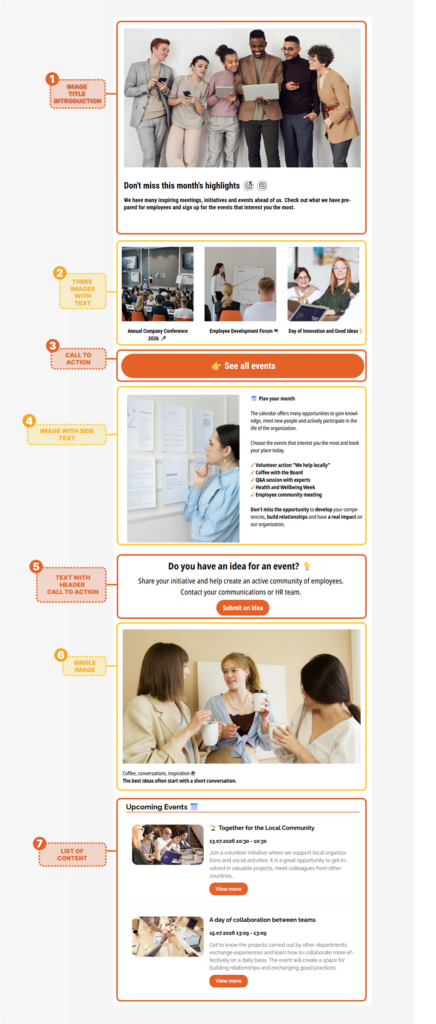
Give the most important event the most visibility, then use smaller sections for other upcoming activities. Include practical information such as the agenda, location or participation details when relevant, and provide a direct link to registration.
You can also use this type of newsletter to bring company life to employees who could not attend previous events.
Photos, highlights or a short recap can create continuity between past and upcoming activities, and make internal events feel like part of a wider story rather than isolated calendar entries.
Example structure:
- Main event of the month.
- Tiles featuring other activities.
- Button linking to the calendar.
- Agenda or practical event information.
- Invitation to submit employee ideas or initiatives.
- Recap of a previous event.
- List of upcoming dates.
How can you create company newsletters faster?
One of the simplest ways to make the process more efficient is to create several reusable templates based on your most common communication needs.
You might have one format for weekly updates, another for events, one for learning initiatives, and another for communicating company results.
This gives editors more time to focus on the message instead of repeatedly rebuilding the layout. It also helps maintain consistency across communication.
Automation can take this further. Automatically displaying recent news, filtering content based on categories or tags, reusing proven content blocks and connecting newsletters with intranet pages, events and forms can significantly reduce manual work.
In Workai, newsletters can direct employees to news, events, forms and other content available within the intranet, making the message part of a broader employee communication experience rather than a standalone email.
How do you measure the effectiveness of a company newsletter?
A newsletter being sent does not mean it achieved its purpose. The metrics you track should depend on what you wanted employees to do.
Open rates and clicks can provide useful context, but they do not always tell the full story. If the purpose of the newsletter was to promote a webinar, registrations may be the most important result. If the goal was to increase awareness of a new procedure, visits to the relevant intranet page might matter more.
Depending on the objective, you may want to look at newsletter opens, clicks on individual pieces of content, visits to intranet pages, event or training registrations, submitted forms and engagement with particular topics.
The key is to connect newsletter performance with the action you actually wanted to generate.
A company newsletter should make information easier to find
An effective internal newsletter does not need to be long or packed with multiple elements. What matters most is having a clear purpose, an easy-to-follow structure, and a logical flow that guides employees towards the most important information or action.
Instead of trying to include everything in a single message, it is better to choose a format that matches a specific communication goal – whether that is summarizing company updates, promoting training opportunities, sharing knowledge, communicating business results, or increasing participation in events.
Reusable templates and integration with intranet content can make newsletter creation faster, help maintain a consistent look and feel, and make it easier for employees to find information that is actually relevant to them.
Summary
An effective company newsletter should make it easy for employees to quickly find the information that matters most. A clear objective, an intuitive structure, strong information hierarchy, and specific calls to action help turn a message from something that simply lands in an inbox into communication that genuinely engages its audience. Depending on your needs, a newsletter can summarize key updates, promote training and events, support knowledge sharing, strengthen company culture, or highlight organizational achievements. Reusable templates and dynamic content can also help teams create newsletters faster while keeping communication consistent and visually engaging. If you would like to explore this further, book a meeting with our expert.