


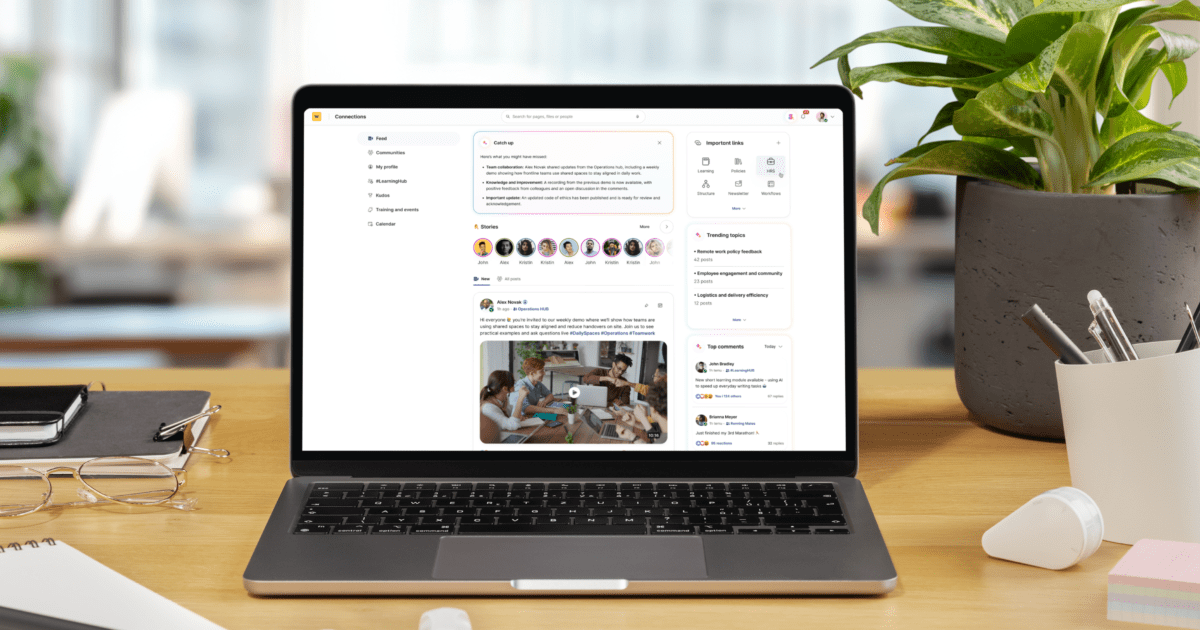
ClearBox Report: Employee Experience in 2026
Organizations turn to market reports and comparison studies when they are facing a concrete decision: modernizing their intranet, bringing order to internal communication, or trying to create a single, cohesive digital workplace. In the context of employee experience in 2026, such reports are rarely read cover to cover. More often, they serve as a reference point – a way to structure the market and understand which technological approaches actually work in mature organizations.
The ClearBox Intranet and Employee Experience Platforms 2026 report was designed with exactly this use case in mind. Instead of focusing solely on feature lists, it analyzes intranet and EX platforms across eight key dimensions, covering both technological and operational aspects. This approach makes it possible to view the digital workplace not as a single tool, but as an ecosystem that must be stable, secure, and capable of evolving over time.
One of these dimensions is Employee Experience, understood not as a set of attractive add-ons, but as the everyday experience employees have when interacting with the intranet, company knowledge, and internal communication. In this context, the report shows how different architectural decisions affect the coherence of the digital workplace, ease of use, and the platform’s real usefulness at scale across the organization.
The foundation of the decision: three EX architecture models
One of the key conclusions of the ClearBox report is that choosing an Employee Experience platform does not start with a feature checklist. It starts with architecture — the “foundation” on which the digital workplace is built. This foundation has the greatest impact on system stability, long-term scalability, and total cost of ownership.
ClearBox identifies three dominant approaches to building EX platforms. Each responds to different organizational needs and comes with distinct operational implications.
Standalone platforms (Workai, Staffbase, Unily)
Standalone platforms are independent SaaS systems that operate outside the SharePoint structure, on their own cloud infrastructure. In practice, this means the entire ecosystem – intranet, knowledge base, forms, and mobile app – is designed and developed as one coherent environment.
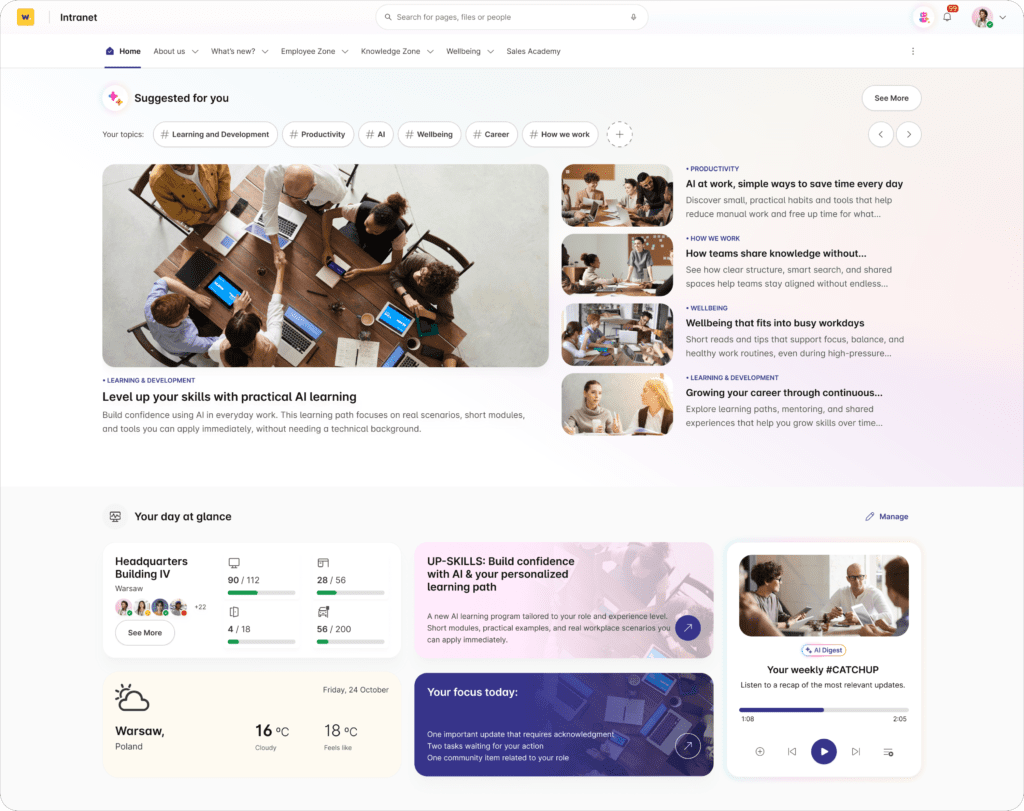
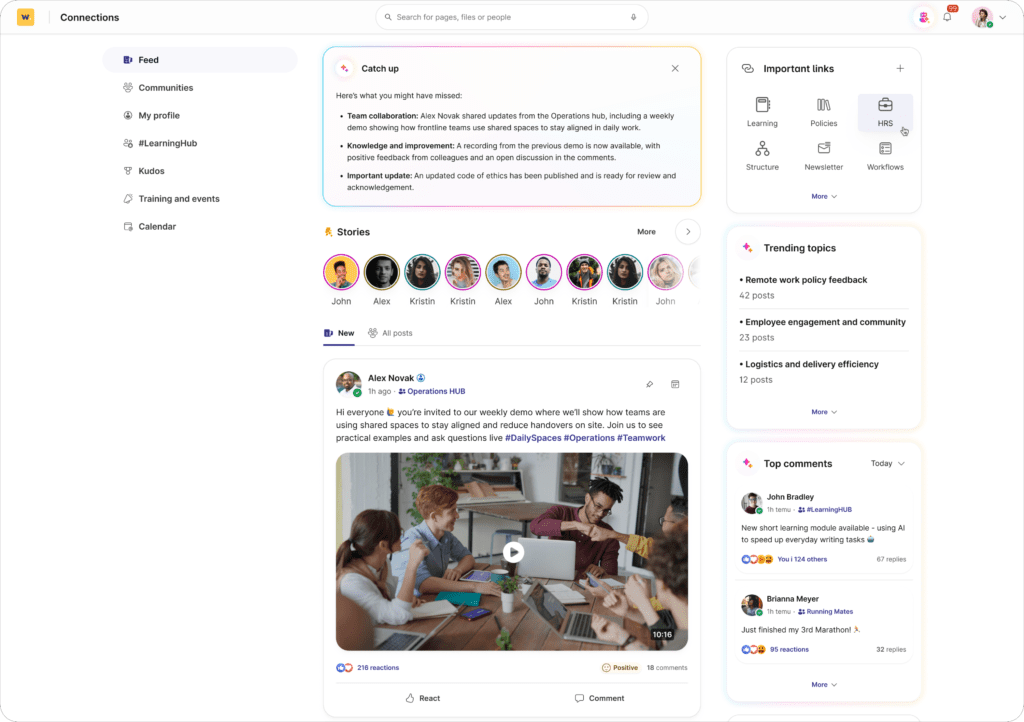
For employees, the difference is most noticeable in everyday use. Regardless of which feature they access, they move within the same interface and follow the same interaction logic. There is no need to switch between multiple applications or learn different navigation patterns.
From an IT perspective, a key advantage is independence from changes in Microsoft 365. Updates introduced by Microsoft do not directly affect the EX platform, making it easier to maintain a stable environment and reducing the risk of unplanned issues following system updates.
SharePoint-native solutions (e.g. Omnia)
The second model is based on embedding the intranet directly within the SharePoint structure. So-called “intranet-in-a-box” solutions leverage native Microsoft 365 mechanisms, offering extensive configuration options and deep integration with the Microsoft ecosystem.
This approach is particularly popular in large, complex organizations that want to maximize the use of their existing SharePoint infrastructure. At the same time, the ClearBox report highlights that this model inherits SharePoint’s change cycle. Updates to page layouts, interfaces, or rendering mechanisms can directly affect how the intranet functions.
In practice, this results in the need for ongoing technical oversight and higher maintenance costs, especially in the long term, when the platform is heavily customized and continuously expanded.
SharePoint baseline (standard Microsoft 365)
The third approach involves building the employee experience entirely on native Microsoft 365 tools, such as Microsoft SharePoint, Microsoft Teams, and Viva.
This option is often perceived as the simplest and most accessible starting point, particularly for organizations already using Microsoft 365. However, ClearBox points out that in this model, the employee experience is often fragmented. Different elements of communication and knowledge are spread across multiple applications, making it difficult to create a single, coherent access point.
As a result, the intranet rarely becomes the central workplace hub, and adoption is often limited, especially in larger organizations, where consistency and simplicity of use are critical.
Governance and implementation: modularity instead of system weight
The ClearBox report shows that in EX platform governance, the key factor is not only the range of available features, but also how they are implemented and scaled over time. In practice, differences between platforms increasingly lie not in whether a function exists, but in whether an organization must deploy an entire system to use it.
Solutions such as Unily or Staffbase are often perceived as highly comprehensive platforms designed for full-scale enterprise environments. While this model offers significant depth, it also means implementing a broad set of capabilities, regardless of whether all of them are actually needed at a given stage of organizational maturity.
ClearBox evaluates Workai as a “versatile and highly modular product“.
In practice, this means organizations can selectively choose functional areas, such as intranet, learning, or social communication, without deploying the full ecosystem from day one.
This approach has a direct impact on ROI. Organizations pay only for the modules that match their current needs, avoiding the costs of maintaining unused functionality. At the same time, the platform’s architecture allows the scope of deployment to expand gradually as digital maturity grows, without the need to replace the system.
In this perspective, EX platform governance is not about maximizing the number of administrative options, but about precisely aligning the system with real business needs – both functionally and financially.
Intuitiveness and low IT overhead
ClearBox emphasizes that EX platform stability depends not only on technical architecture, but also on how easy the platform is to manage on a day-to-day basis. In practice, the greater the reliance on specialized IT expertise, the higher the operational risk and long-term maintenance costs.
For more complex SharePoint-native solutions such as Omnia, ClearBox points to a steep learning curve for administrators and the need for advanced technical skills. This model can work well in organizations with large IT teams, but it also increases dependency on specific roles and resources.
Workai enables management of content and intranet structure without specialized technical knowledge.
Using an AI-supported drag-and-drop editor and a consistent interface across all modules. As a result, responsibility for platform development and maintenance can be shared across communication, HR, and operational teams, without involving IT in everyday activities.
A low technical barrier translates directly into faster adoption, greater organizational flexibility, and lower maintenance costs. In the long term, this means greater resilience to staff changes, team reorganizations, and increasing scale of use – factors that are critical for the stability of a digital workplace.
AI-native instead of AI-added: technology in everyday work
The ClearBox report notes that the Employee Experience platform market has reached a high level of consistency in terms of interface and basic UX patterns. As a result, differences between solutions increasingly relate not to appearance or navigation, but to how platforms address information overload, one of the main challenges of the digital workplace today.
In this context, ClearBox highlights the growing role of artificial intelligence — not as a technological add-on, but as a mechanism for structuring employees’ daily interaction with content, knowledge, and internal communication. The key question is no longer whether a platform uses AI, but how deeply it is embedded in the user experience.
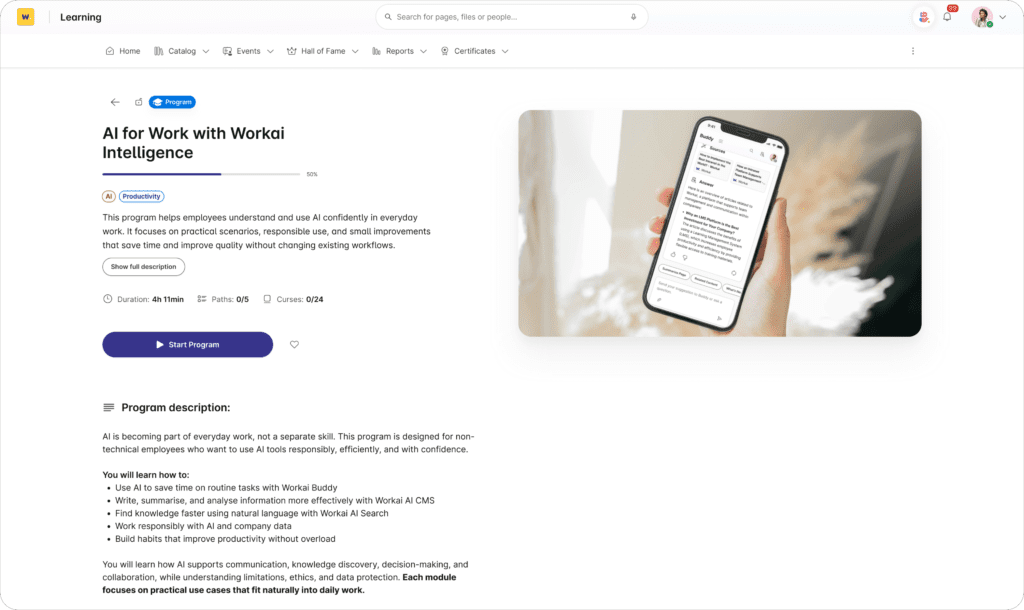
Workai was designed as an AI-native platform, where AI-powered features are an integral part of the interface.
The Workai Buddy assistant, automatic page summaries, and the “Content Vitality” dashboard support users in understanding, filtering, and evaluating content, without requiring context switching or additional tools.
This approach means AI is not a one-off novelty, but a practical solution to information chaos, improving communication quality and access to company knowledge. In practice, the difference between AI-added and AI-native lies not in the number of features, but in whether the technology genuinely solves problems employees face every day.
Frontline workers and economies of scale: mobile as a full work environment
ClearBox points out that in many EX platforms, mobility is still treated as an extension of the desktop experience. In such cases, the mobile app serves primarily as an additional access channel to content originally designed for desk-based work, limiting its usefulness for frontline employees.
This approach may be sufficient in organizations with a high proportion of office workers, but in manufacturing, logistics, or retail environments, its limitations quickly become apparent. Frontline employees need fast, contextual access to information that can be used while performing tasks — often without the ability to focus fully on a screen.
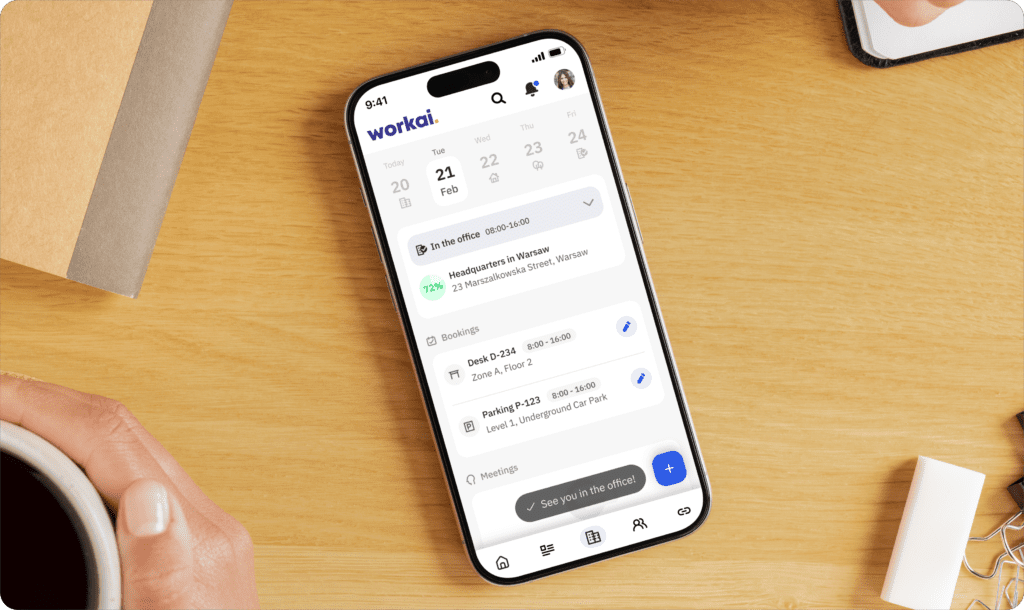
Workai delivers a Single Point of Entry, providing a consistent experience across devices.
Mobile is not an add-on to desktop, but an equal work environment designed for real operational conditions.
An example of this approach includes frontline-focused features such as AI-generated podcasts, enabling hands-free content consumption. ClearBox identifies such solutions as an emerging standard for EX platforms in 2026, emphasizing their importance for workplace safety, information accessibility, and real system adoption among operational staff.
In practice, this approach supports not only a better user experience, but also effective scalability. A single, unified work environment for all employee groups reduces the need for parallel tools and simplifies communication management in large, diverse organizations.
Secure integration with the Microsoft ecosystem
ClearBox shows that integration with Microsoft 365 is now a market standard, but the way this integration is implemented has a significant impact on long-term EX platform stability. Differences between solutions are not about whether they integrate with SharePoint, but about how deeply they interfere with its structure.
In SharePoint-native platforms such as Omnia, integration often involves modifying master pages, templates, or the presentation layer. While this allows extensive customization, it also makes the intranet sensitive to changes introduced by Microsoft.
Workai integrates with Microsoft SharePoint without interfering with its structure.
No JavaScript injection or CSS modifications means Workai does not alter page layouts, templates, or rendering mechanisms.
In practice, this results in high resilience to Microsoft 365 updates. Even when changes on Microsoft’s side affect solutions based on deep SharePoint modifications, Workai remains stable and requires no technical intervention. For organizations, this means lower risk of communication downtime, reduced maintenance costs, and greater long-term predictability of intranet performance.
Conclusions
Reports like ClearBox rarely provide a single, straightforward answer, and that may be exactly why they are most valuable. Instead of closing decisions within comparison tables, they encourage organizations to ask critical questions: how complex an environment do we want to maintain, who will actually use it, and will a system that looks impressive today remain just as useful in a few years?
Employee Experience in 2026 is increasingly defined not by individual features or trendy add-ons, but by whether the digital workplace is coherent, predictable, and resilient to change, both technological and organizational. Whether it allows gradual development without the need to constantly “rebuild” its foundations.
From this perspective, choosing an EX platform is no longer a decision about a tool, but about how an organization works with information, knowledge, and communication. And in this sense, ClearBox does not so much name market winners as point to a direction: toward simpler, more flexible architectures that do not get in the way of work, but quietly support it.